
When the Children and Youth Behavioral Health Initiative (CYBHI) began taking shape, many Local Educational Agencies faced an urgent and understandable question: How do we stand up documentation and billing quickly?
For some LEAs, a single-purpose EHR built primarily for CYBHI appeared to be a practical answer. At the time, leaders sometimes told us that keeping programs in one platform was not a priority. CYBHI could operate separately; other teams could continue using their existing systems and spreadsheets.
Today, the conversation changed. LEAs are seeing that an EHR decision is not merely a purchasing decision for one funding stream. It is a decision about the information infrastructure that will support a child across school-based health, behavioral health, special education, compliance, and reimbursement workflows.
The Cost of a Fragmented View
A single-purpose system may solve an immediate program need, but fragmentation becomes more visible as services expand. Separate platforms can create duplicate student records, repeated demographic and insurance collection, disconnected consent and authorization workflows, multiple user accounts, conflicting reports, and added training and vendor management.
The greatest cost is not simply administrative. It is the loss of context. When information about the same child is distributed across systems, each team may see only one slice of the story. Program leaders spend time reconciling data instead of acting on it, while practitioners repeat work that has already been completed elsewhere.
The One Child Record Vision
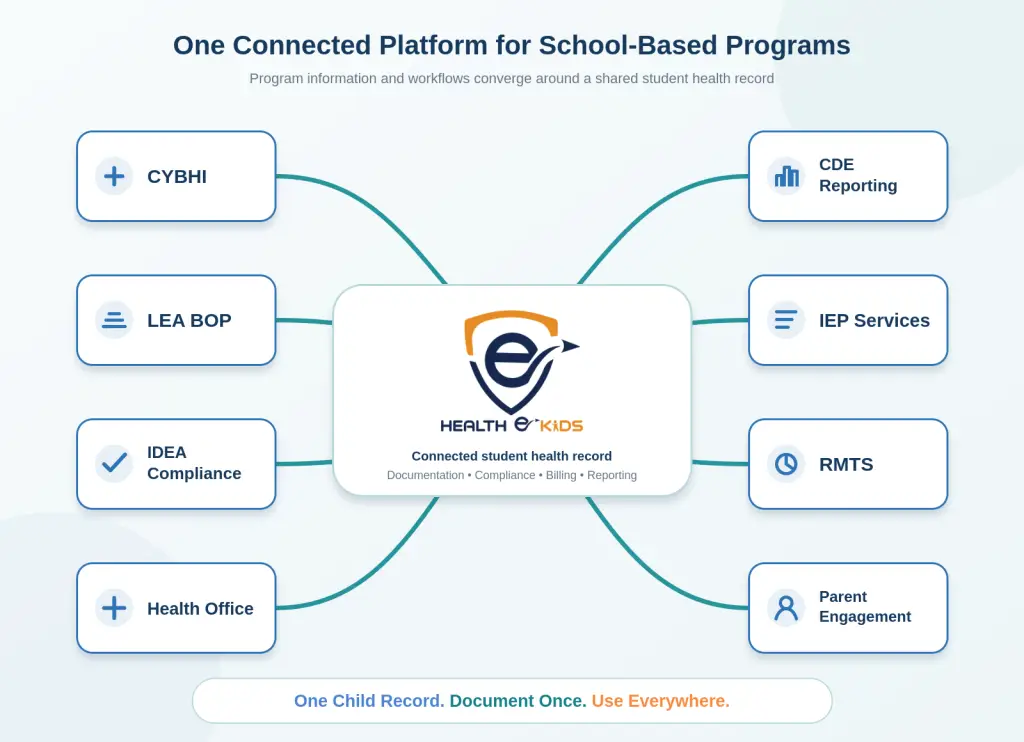
The Navis Children’s Platform is built around a different idea: the child, not the program, claim type, or department, should be at the center of the record. One Child Record creates a trusted, longitudinal foundation that can connect the people, services, plans, documentation, and financial workflows surrounding each student.
This does not mean every user sees everything. Role-based access, privacy protections, and program rules remain essential. It means authorized teams can work from a consistent source of truth rather than building parallel versions of the same child’s information.
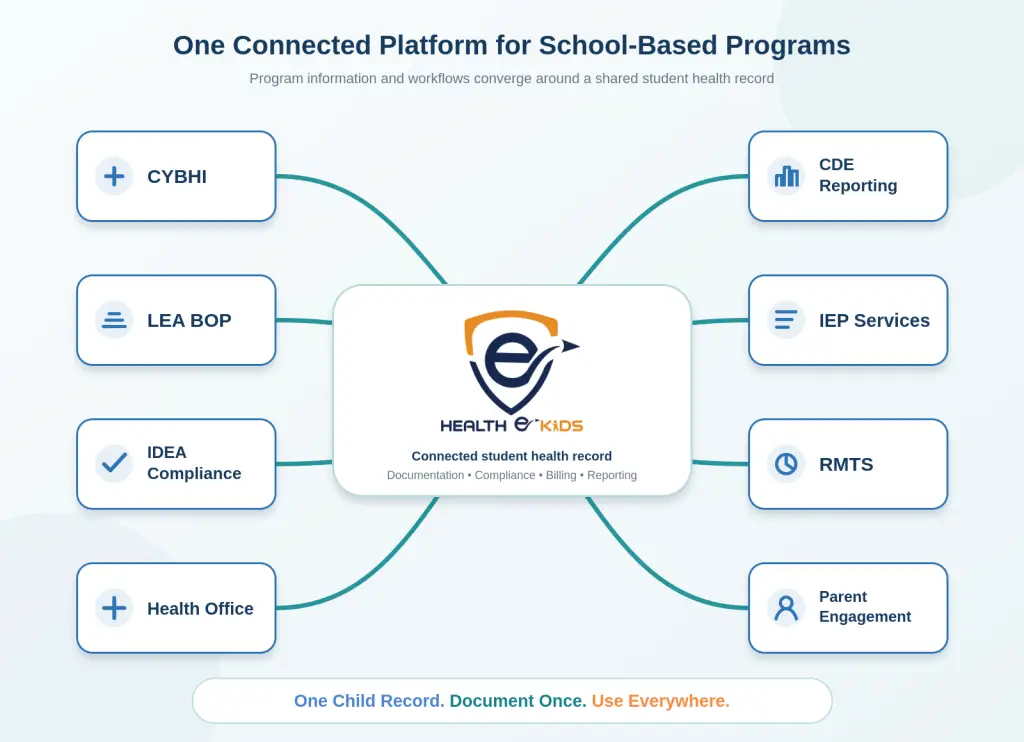
Document Once – Use Everywhere.
A connected platform allows one well-documented action to support multiple authorized purposes. A service entry may contribute to care continuity, plan implementation, progress monitoring, supervision, compliance reporting, and billing eligibility, without asking staff to recreate the same work in multiple places.
That principle turns integration into a practical daily benefit:
- One identity. Student demographics, contacts, insurance, consents, plans, authorizations, and service history remain connected.
- One workflow. Practitioners document in a familiar environment while rules, validations, and follow-up operate behind the scenes.
- One operational view. Leaders can see program health, service delivery, compliance, claims status, and reimbursement trends without manually reconciling disconnected reports.
- One foundation for growth. LEAs can extend into new programs and workflows without starting over with another isolated record system.
More Than an EHR: A Connected Children’s Platform
Health e Kids’ platform supports the interconnected work LEAs already manage: CYBHI, the LEA Medi-Cal Billing Option Program, IDEA plan implementation and CDE reporting, health office services, RMTS, and related documentation and revenue cycle workflows. Capabilities such as customizable notes, care plans, referrals, electronic authorization, supervision, insurance and consent collection, claims monitoring, dashboards, and financial reporting can operate around the same child record.
This is the shift from buying software for a program to building a platform for children. Programs can evolve. Funding rules can change. New initiatives will emerge. The One Child Record remains the durable center that helps an LEA adapt without multiplying systems and administrative burden.The Workflow
Technology Is Only Half the Equation
School-based billing and compliance require more than a technically capable EHR. They require practical knowledge of provider qualifications, documentation standards, supervision, consent, insurance information, claim validation, reconciliation, cost reporting, and changing guidance.
The Navis Group suite of services brings over 30 years of California school-based billing experience to the platform. LEAs receive technology, revenue cycle management, training, consulting, and ongoing support from an experienced team that understands how school-based programs operate. When a documentation, compliance, or reimbursement question arises, clients are not left to determine which vendor owns which part of the workflow.
From Optional Convenience to Strategic Priority
What once sounded like a convenience, keeping programs in one system—is increasingly becoming a strategic priority. LEAs want less duplication, clearer oversight, stronger continuity, and a technology partner capable of supporting today’s requirements and tomorrow’s opportunities.
Our “One Child Record” vision offers a clear answer: start with the child, connect the work, and create an information foundation that can serve every authorized program and team.
Case Study: Connecting Behavioral Health and IEP Services Around One Student
A middle school student with an IEP receives speech-language services and school-based counseling for anxiety. The student is also referred to a CYBHI behavioral health provider after increased absences, classroom withdrawal, and difficulty participating in group activities.
In separate systems, the CYBHI provider may see the student’s behavioral health assessment and treatment notes but have little visibility into relevant IEP goals, service history, accommodations, or progress indicators. Likewise, the IEP team may not have timely access to authorized information showing how anxiety is affecting the student outside scheduled special education services.
With appropriate consent, role-based access, and privacy protections, a connected One Child Record gives each provider access to the relevant information needed to coordinate care. The CYBHI provider can see that the student’s IEP includes communication and classroom-participation goals, while the IEP team can incorporate authorized behavioral health insights into service planning and progress monitoring.
This shared context helps the providers establish coordinated strategies. For example, the CYBHI provider may help the student develop coping skills for group participation, while the speech-language pathologist reinforces those strategies during communication activities. The team can then monitor related indicators, including attendance, participation, service utilization, goal progress, and reported anxiety, without requiring the student or family to repeatedly explain the same history.
Potential Student Outcomes
A connected record can help the team:
- Identify relationships between behavioral health needs and IEP goal progress
- Coordinate interventions across counseling, classroom, and related-service settings
- Recognize changes in attendance, participation, or functioning sooner
- Reduce conflicting or duplicative plans
- Make better-informed service adjustments
- Provide the student and family with a more consistent experience
The result is more than administrative efficiency. Relevant information follows the student across authorized programs, helping providers see the whole child and work toward shared outcomes.